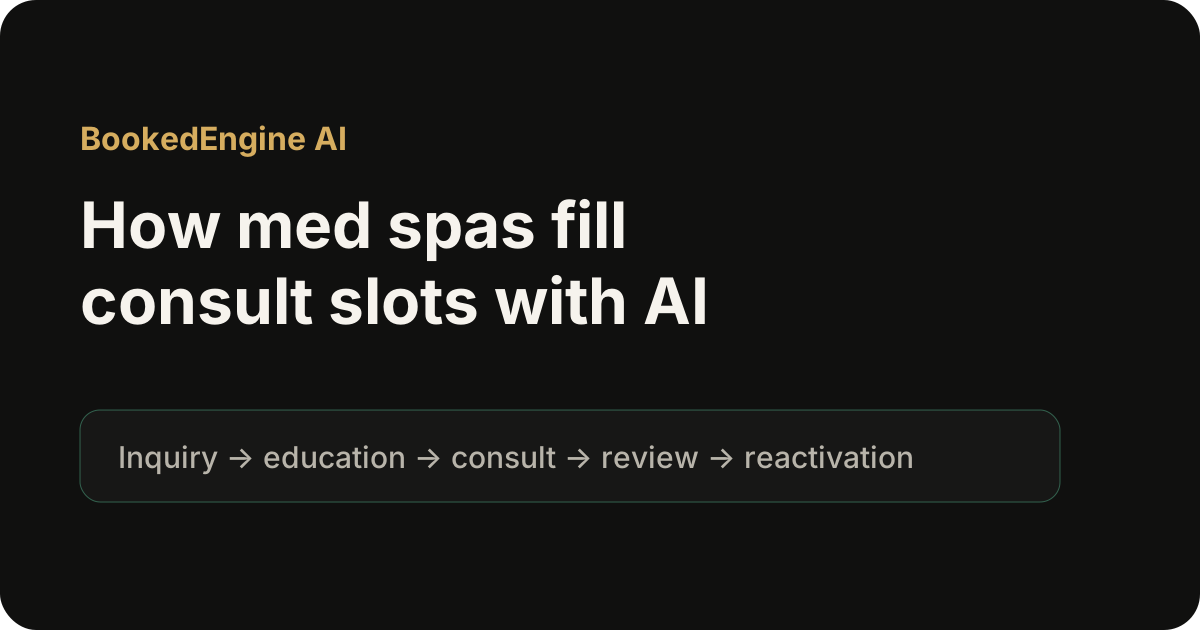
Guide
Practical workflow notes.
The most common revenue problem at a med spa is not marketing spend. It is what happens in the 10 minutes after a prospective client submits a contact form at 8pm.
In most med spas, what happens is nothing — until the next morning, when a front desk coordinator sees the inquiry in the inbox, sends a manual reply, and hopes the prospect is still interested. Some are. Most have already booked elsewhere or lost the impulse entirely.
The speed-to-lead problem in aesthetics
Med spa treatments — Botox, filler, laser, body contouring — are considered purchases. The prospective client has usually been thinking about it for weeks or months before they submit that form. When they finally do, they are ready to take the next step. The practice that responds first gets the consultation.
Research on lead response time shows that the odds of making meaningful contact with a new inquiry drop by over 80% if the first response takes longer than 5 minutes. In a category where the average response time is measured in hours, a practice that responds in minutes has a structural competitive advantage.
What "AI follow-up" actually means
AI follow-up for a med spa is not a chatbot that answers questions. It is an automated sequence that:
- Sends an immediate response to every new inquiry — web form, missed call, or DM — within 1–5 minutes
- Personalizes the message to the specific treatment the prospect inquired about
- Offers two or three specific appointment times or a scheduling link
- Follows up once more if there is no response within 24 hours
That sequence runs automatically, at any hour, without a staff member remembering to send it. The front desk still handles the actual conversation — the system just makes sure no inquiry falls through the cracks.
The treatment education gap
There is a second follow-up problem that happens before the consult, not after.
Most med spas do all of their treatment education on the consultation call. The prospect shows up knowing almost nothing about the procedure, the recovery, the pricing, or what to expect. The consultation is spent on basics instead of building confidence and moving toward a booking.
A pre-consult education sequence — three to five messages sent in the days between inquiry and appointment — changes that conversation. The client arrives informed, has fewer objections, and is further along the trust curve before anyone has spoken a word.
Review velocity as a booking driver
A med spa's Google review count and rating are visible on every search result. A practice with 400 reviews and a 4.9 rating gets clicked first, regardless of where it ranks. A practice with 40 reviews and a 4.3 rating loses the click before the prospect even visits the website.
Most med spas generate reviews through verbal asks at checkout — inconsistent and easy to forget. An automated review request sent by text 24–48 hours after a completed treatment, with a direct link to the Google review page, generates review velocity that compounds over time.
The math is simple. If a practice completes 80 treatments per month and converts 20% of automated review requests into actual reviews, that is 16 new reviews per month. Over a year, that is 192 reviews — a transformation of the practice's online reputation.
Reactivating past clients
Every med spa has a database of past clients who have not booked in 90, 120, or 180 days. That list represents known demand — people who have already trusted the practice enough to pay for a treatment.
A reactivation campaign to that list, segmented by last treatment date and treatment type, with a specific offer tied to a natural follow-up treatment, consistently recovers bookings. It is the lowest-cost acquisition channel available because there is no stranger trust gap to cross.
What to build first
If a med spa is running 20 or more inbound inquiries per month, the highest-leverage starting point is always the consult follow-up sequence. Fix the response time, capture the inquiries that are currently going cold, and establish a baseline before adding treatment education, review automation, or reactivation.
A revenue leak audit maps where the biggest drop-off is happening so the first build is focused on the highest-value fix, not the most obvious one.